Nothing moves until a person approves it
The language model writes the plan. The twin checks it. Your team decides. That order never changes, and the bridge beside the robot enforces it.
- 1 Plan
- 2 Simulate
- 3 Approve
- 4 Run
From words to motion
-
Plan
You describe the task. The planner turns it into named steps you can read, not a black box.
-
Simulate
The plan runs on a digital twin of your cell with the real arm's kinematics and joint limits.
-
Approve
A person on your team reviews the motion and the checks, then approves it. Or doesn't.
-
Export
Only approved plans become robot code, which runs inside the safety system your integrator set up.
It slows down for people.
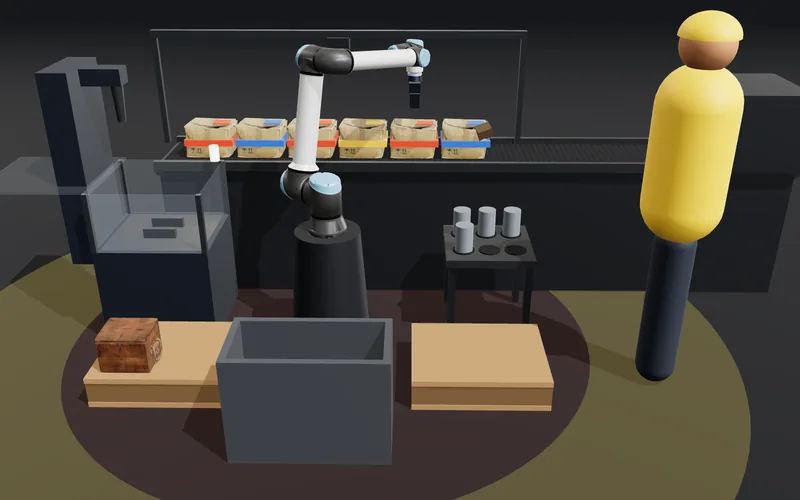
In the Studio you can walk a person into the cell and watch the arm respond. The same zones are written into the exported program, so the plan you approve already knows where people stand.
What we check, every time
- Reach and joint limits
- Every target is solved with the arm's real inverse kinematics. Out of reach means the plan stops there.
- Collisions
- Paths are checked against the cell's fixtures, pallets, conveyor and the objects already placed.
- Payload
- Object weights are compared with the arm and gripper rating before anything is picked.
- People nearby
- In simulation, the arm slows when someone enters the warning zone and stops in the protective zone.
- Stack stability
- Layers, heights and placements are checked so a pallet pattern is buildable, not just drawable.
- Honest failure
- When a request isn't possible, the planner says why instead of guessing. Unclear instructions get a question back.
It looks before it picks.
The infeed camera labels every box by colour and flags damage, so a crushed or leaking box goes to the reject bin instead of onto a customer's pallet.
Standards and responsibility
Seventh Axis is software. It doesn't replace your cell's safety system, and it doesn't certify a cell. Guarding, light curtains, area scanners and the risk assessment stay with your integrator, following ISO 10218 for industrial robots and ISO/TS 15066 where people work alongside collaborative arms.
Exported programs run inside the limits the robot controller already enforces. Our checks are an extra layer on top, so problems are caught at a desk instead of on the floor.
The Studio playground can throw and toss boxes for fun. Those moves are simulation-only and can never be exported.
Your data
We handle personal data under Malaysia's PDPA. Instructions you type are sent to our AI provider only to produce a plan or an answer, and we don't sell data or use it for advertising. The details are in our privacy notice.
Found a security or safety issue? Please email us. We'll reply within two working days and credit you if you'd like.